
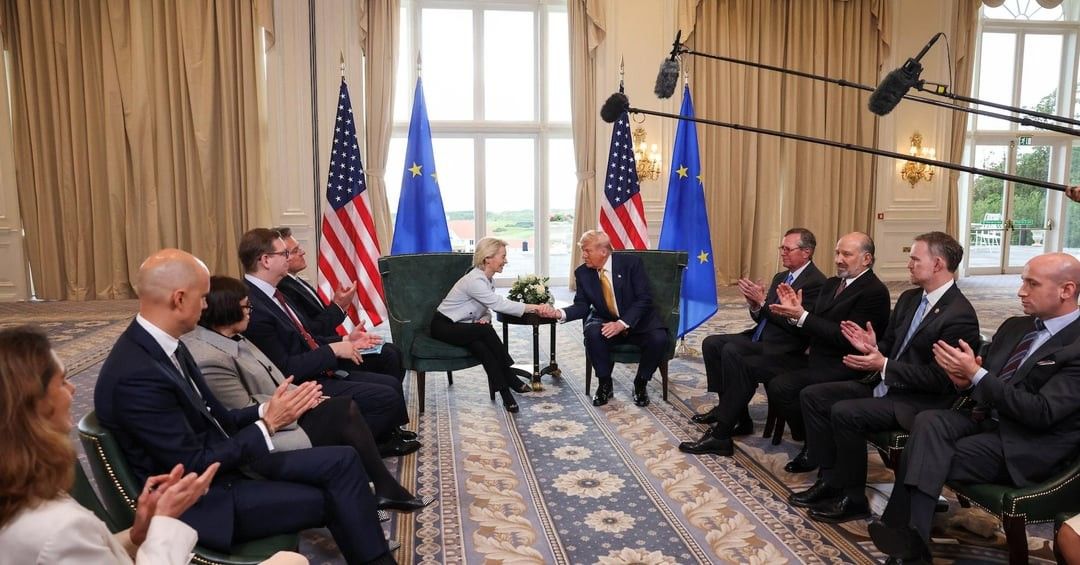
A trade agreement was reached on Sunday, 27 July in Turnberry, Scotland, between European Commission President Ursula von der Leyen and US President Donald Trump concerning tariffs imposed by the United States on products from the European Union.
Since 2 April, President Trump has repeatedly threatened the EU and its industries with the unilateral imposition of prohibitive tariffs, particularly on wines and spirits. Faced with this pressure, the European Commission, mandated to represent the Member States, has chosen to prioritise stability at all costs, to the detriment of a balanced power dynamic with Washington.
In its current form, this agreement risks severely impacting several economic sectors. AREV regrets that such a strategic compromise was made without transparency for the wine sector. This gives the impression that the European Union is uninterested in defending its agricultural interests.
The President of the Assembly of European Wine Regions (AREV), Franck LEROY, voiced his deep concern:
“The lack of clarity regarding the wine sector in this agreement is particularly worrying. After a European budget proposal for 2027–2034 that reduces the CAP to a bare minimum, this is yet another agreement that sidelines viticulture.”
The figures speak for themselves: the United States imports around $5.4 billion of wine and $3.2 billion of spirits from the EU each year. These exports represent far more than just economic value: they embody craftsmanship, a way of life, and a shared heritage — and contribute to the vitality of our wine-growing regions.
Franck LEROY concludes:
“Only a strong, sovereign and united Europe will be respected, will make its voice heard in international negotiations, and will protect its territories effectively. The road ahead is long. But one thing is certain: submission has never led to success.”


