
ABOUT AREV
What is the AREV?
The Assembly of European Wine Regions (AREV) is an associative structure that defends and promotes the interests of European wine regions, whose originally is based on a unique double legitimacy, consisting of elected representatives of the regions, elected by the people, and representatives of professional organizations in the wine sector.
The Conference of European Winegrowing Regions (CESR), created in 1988 in Bourg-sur-Gironde, Aquitaine, on the initiative of Gironde, officially became the Assembly of European Winegrowing Regions (AREV) in 1994 in Marsala, Sicily, with the adoption of new statutes. new statutes which strengthened the institution’s effectiveness.
In applying the major principles of participation and subsidiarity at European level, the Regions play a crucial role in as much as they represent European citizens, not as individuals, within the framework of the European Parliament, but as communities.
The sectoral policy that the Commission has been implementing for decades is less and less in line with the territorial expectations of local and regional authorities and civil society. In this respect, the involvement of regional politicians in this dialogue is essential, since it is not only the socio-economic fabric of the region and its many family-run farms that are at stake, but also the development of our territories, our landscapes, our environment and the diversity and quality of our wine production. Everything that is decided in Brussels directly affects the regions and the citizens, whose regional political representatives have a moral responsibility to make their voices heard on all issues.
ORGANIZATION
The President of the AREV, elected for two years, is necessarily the President of a European member Region.
The professional representatives, who cover all the actors in the wine sector at regional level, are grouped together in the European Wine Professional Council (CEPV), which is responsible for drawing up the texts to be submitted to the Plenary Assembly for approval. The President of the CEPV is, by right, the First Vice President of the AREV.
The European wine producing regions (both from the European Union and from the countries of Central and Eastern Europe, admitted since its creation in 1988) each have a political and interprofessional representation within the AREV.
POLITICAL AND PROFESSIONAL SYNERGY
For the first time in European interregional organisations, representatives of the regional professional world are seated, as an economic and social council, alongside the political representatives of the regional institutions.
This duality has the great advantage of allowing the professional world to be heard with all the precision and technicality of its experience, while benefiting from the support of regional political institutions and the strength that emanates from their democratic legitimacy. The President of the AREV, elected for two years, is necessarily the elected President of a European region.
The professional representatives, who cover all the actors in the wine sector at regional level, are grouped together in the European Wine Trade Council (CEPV), which is responsible for drafting the texts to be submitted to the Plenary Assembly for approval. The President of the CEPV is ex officio the first Vice-President of the AREV.
After more than thirty years of work and meetings held in most regions to better understand the specific features and problems encountered, the AREV has learned to identify the guiding principles of a wine policy that wisely combines the general interests of the entire sector (from producers to consumers) with the specific features and traditions of each region.
Thanks to its dual representativeness, the AREV works with all the institutions and entities directly or indirectly responsible for European or world wine policy and is involved in all wine-related matters.
Interlocution
AREV is a privileged partner of the following institutions:
- European Commission: Directorates of Agriculture, Internal Market, Trade, Economic Affairs/Eurostat, Environment, Regional Policy, Wine Management Committee, among others.
- Intergroup on Wine, Spirits and Foodstuffs.
- European Parliament: Viticulture Intergroup, Agricultural Commission (COMAGRI).
- European Council: Committee on the Environment and Agriculture, Congress of Local and Regional Authorities.
- Committee of the Regions: Agriculture Committee.
- Assembly of European Regions (ARE).
- International Organization of Vine and Wine (OIV).
- World Trade Organization (WTO).
Participation
The AREV is involved in projects on:
- The Common Organization of the Market in Wine (CMO-wine).
- Viticulture of candidate countries.
- Viticulture in steep slope vineyards, in collaboration with the Centre for Research, Studies and Development for Mountain Viticulture (CERVIM).
- Taxes / Excise duties.
- Protection of Protected Geographical Designations (PDO) and Protected Geographical Indications (PGI).
- Harmonization of labelling mentions.
- Organic viticulture.
- New Genomic Techniques (NTG’s).
- Computerisation of commercial accompanying documents.
- Wine tourism, European wine routes.
- Wine and health.
- International Sommeliers Academy.
ORGANISATIONAL STRUCTURE
PRESIDENCY

Franck Leroy
President


EUROPEAN PROFESSIONAL WINE COLLEGE (CEPV)

GENERAL SECRETARIAT

LATEST NEWS
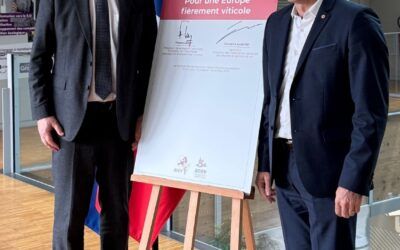
AREV launches in Strasbourg a call for a proudly winegrowing Europe
Gathered in Strasbourg on 20 and 21 October at the invitation of the Grand Est Region, the General Assembly of the Assembly of European Wine Regions (AREV) and the European Committee of Wine Professionals (CEPV), together with Farm Europe, La Coopération Agricole and...

EU–US Trade Agreement: AREV concerned by the lack of clarity regarding the wine sector
A trade agreement was reached on Sunday, 27 July in Turnberry, Scotland, between European Commission President Ursula von der Leyen and US President Donald Trump concerning tariffs imposed by the United States on products from the European Union. Since 2 April,...

Single Fund and the Future of the CAP: AREV Warns of a Concerning Shift for European Agriculture
AREV has taken note with deep concern of the 2027–2034 budget proposal presented by the President of the European Commission. This project represents a major shift that weakens the Common Agricultural Policy (CAP), undermines its foundations, and increases the divide...


